I have been looking at Nifty strangles for a while and the results seem to be very encouraging. Essentially it’s about buying an option strangle – a lower strike put and a higher strike call – near the money, for a quick turnaround in these markets.
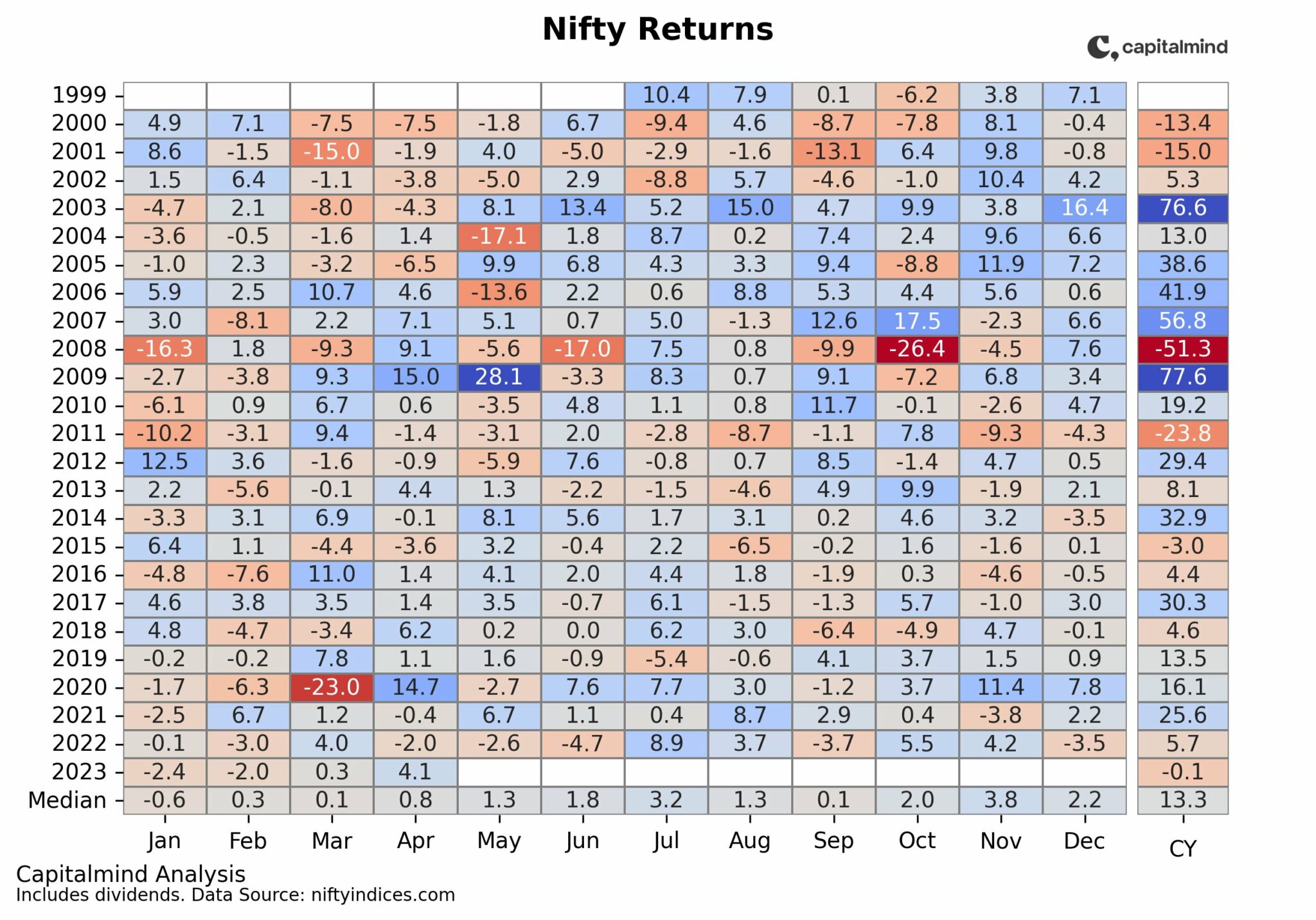
I’d mentioned last about a 50% return, and later a 38% return, on a September strangle, which were reasonable. Those were based on a hypothesis that the Nifty moves dramatically after being range bound for a few months. (And how that is true in October!)
This month, I decided to start off with a strangle. And then chickened out. A 4000 call/3800 put strangle cost me Rs. 287. I sold out for Rs. 249, incurring a 20% loss. In hindsight I would have got over 1400 for it if I had held till now – but that’s teaching me a lesson. (Remember this is per lot of Nifty, size 50 each)
I then decided when the Nifty moved a lot, that implied volatilities were through the roof. the Nifty was around 3300 then – so I said, heck, the Nifty isn’t sticking around here too long. So a 3300/3400 strangle was bought, for Rs. 135/123 – a total of Rs. 258 per Nifty – on a per-lot level, this is an investment of about 12500. (I usually buy larger quantities, and there is enough liquidity to take in enough)
The idea was to hit the strangles when the IV was very high and the market had just moved a considerable amount, and the target was around 30%.
Sure enough, the Nifty went down to 3050 in a couple days, netting me Rs. 335 on the return side – I cashed in, with a 30% return.
And today I saw the volatility going nuts again, and I bought yet another strangle – this time a November 2850 put, 2900 call – for a premium of Rs. 500 total. And that is up to about Rs. 570 today, though I still have a 30% target.
I’m now considering systematising this – a) buy strangles when the market stays rangebound for over two months, and b) buy strangles when the IV goes to ridiculous highs (like 55+).
I know the first part has had very good results in the recent past. I also know the second part has worked recently too. It will be interesting to see if the theories still hold.
Also need to investigate optimum profit targets (or a trailing stop loss) and an optimum holding period. Can’t initiate a strangle in the last few days of expiry – that’s one thing I’ve learnt.
Position sizing here is tough. Since premium is very very volatile, you can’t put all your money in there – perhaps 10-15% of the money goes in each time. So even a 30% return is like a 3% return on your whole portfolio – still decent. I need to experiment with various levels. But the preliminary tests are very interesting.